
In-Motion and Static Load Volume Scanning
When evaluating a Load Volume Scanner for truck volume measurement, one of the most important questions is simple: Should trucks be scanned while moving, or while stopped?
The answer depends on your site priorities. Some operations care most about throughput, while others care most about precision and repeatability. In practice, these two scanning modes serve different purposes.
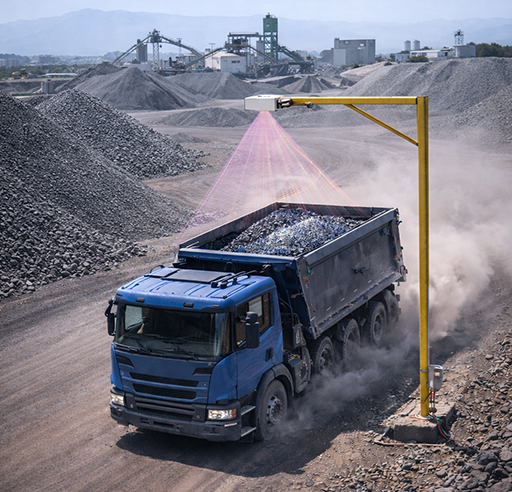
What is In-Motion scanning?In-Motion scanning means the truck drives through the scan zone without stopping. The system automatically captures the load as the vehicle passes under the scanner.
This is the preferred option for sites that want fast traffic flow, minimal driver intervention, and high operational efficiency. In quarries, mines, and construction sites with many truck movements per day, this can be a major advantage.
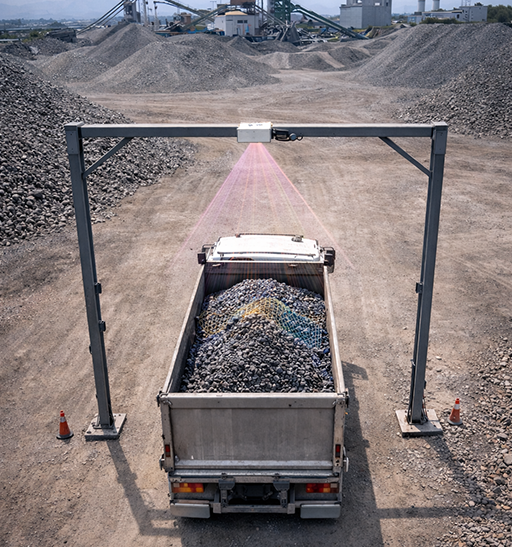
Static scanning means the truck briefly stops in the scan zone while the system captures the load.
Because the truck is not moving during the scan, static mode removes many of the variables that can affect measurement quality in a drive-through capture. That usually makes it the better option when the goal is maximum precision, a stable empty baseline, or validation of a new truck body type.
In-Motion scanning is mainly about speed and automation. It keeps trucks moving and reduces delays. But because the truck is moving, the measurement depends more on operating conditions such as speed consistency, straight approach, lane position, road smoothness, and limited sway.
Static scanning is mainly about control and confidence. By stopping the truck, the system avoids many motion-related error sources, such as acceleration, braking, vibration, lateral bucket movement, and distortions caused by reconstructing a moving object.
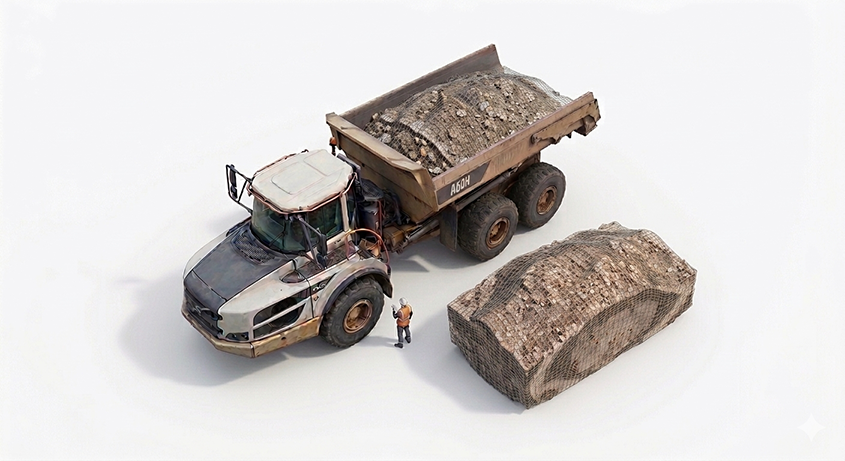
In today’s market, these two modes are often offered as separate solutions.
Many in-motion systems are built around profile-based scanning and need additional tracking of vehicle movement so the load can be reconstructed correctly during a pass. Static solutions are also commonly offered as their own setup, and some rely on moving sensor mechanics or a different hardware arrangement to capture the full load accurately.
That means some buyers end up choosing between a system optimized for traffic flow and another optimized for stationary precision.
Where Tolveet is differentTolveet takes a different approach.
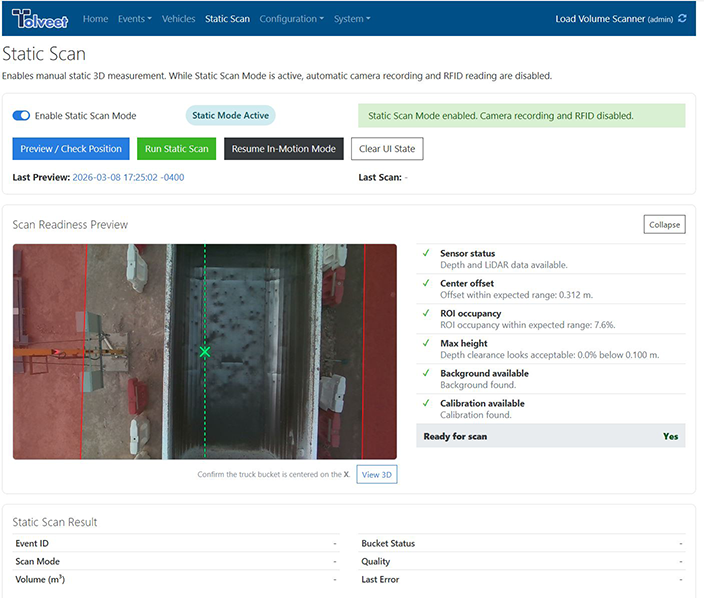
Because Tolveet uses fully 3D sensor fusion (Vision & LiDAR) and AI for speed estimation and 3D reconstruction, it can offer both In-Motion and Static scanning in the same hardware, selectable by software. In other words, the site does not need one scanner for drive-through operation and another for static measurements.
This gives operators more flexibility. A site can run automatic In-Motion scans for daily production, then switch to Static mode when it wants the highest-confidence measurement for empty capacity, commissioning, troubleshooting, or difficult site conditions.
Choose In-Motion if your priority is:
- High throughput
- Minimal driver stops
- Automated daily operation
Choose Static if your priority is:
- Maximum precision
- Better repeatability
- Difficult road or approach conditions
- Building a reliable empty reference
For many sites, the best answer is not one or the other. It is having access to both modes depending on the task.
At the end of the day, the decision is simple:
In-Motion scanning maximizes operational flow. Static scanning maximizes measurement confidence. The best load volume scanning systems are the ones that match how your site really works.
was originally published in on Medium, where people are continuing the conversation by highlighting and responding to this story.